Our Key Takeaways from AIConf 2026
Starting Our 2026 with AI Conference
Last week, the HuSig.ai team had the privilege of attending AI Conf 2026: AI in Action, dubbed as Nepal’s first major AI conference, held on January 10 and 11, 2026, organized by Web Weekend Kathmandu (wwktm). The event brought together artificial intelligence practitioners, global researchers, and business leaders with engineers, designers, and AI builders from Nepal to share practical insights on building, deploying, securing, and evaluating AI in real products and systems.
As a company building AI-driven solutions, this conference aligned closely with our mission. It offered not only technical depth but also thoughtful perspectives on responsibility, security, design, and long-term impact.
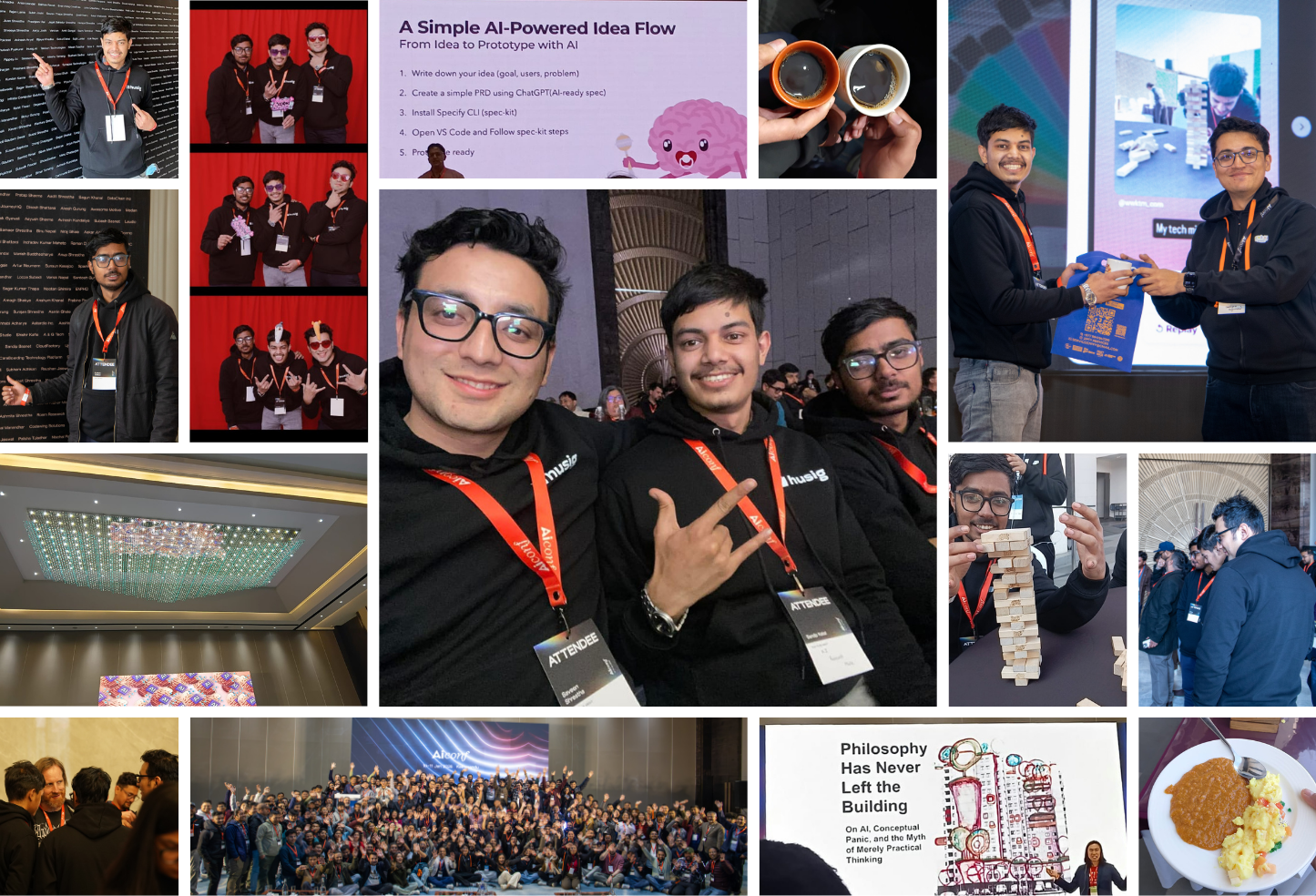
Our team — including Sandip Katel, Subham Adhikari, and myself — represented HuSig.ai at the conference, engaging deeply with speakers, fellow practitioners, and the broader AI community.
Why AI Conf 2026 Matters
The rapidly evolving Nepali tech ecosystem has been shifting from curiosity about AI toward real-world applications and product-grade systems. AI Conf 2026 successfully captured this momentum, focusing on applied AI — from system design and governance to security and evaluation — moving conversations beyond theory into action.
Key Themes That Resonated with HuSig.ai
AI Conf 2026 stood out for its emphasis on applied AI rather than hype. The sessions focused on real systems, real users, and real constraints — topics that directly reflect the challenges we work with every day.
Some of the most impactful talks included:
Modern AI Systems & Workflow Automation
Manu Chatterjee provided a systems-level view of how modern AI applications convert unstructured inputs into decisions and workflows, offering valuable insights into scalable AI architecture.
Generative AI in Healthcare
Amit Timalsina (Kathmandu-based engineer) shared practical lessons on leveraging generative AI for clinical trial reviews — transforming massive, unstructured medical documents into insights and dramatically reducing review time at production scale.
Humanity-First AI and Long-Term Impact
Haihao Liu (Founder & CEO, Ternity Education) framed AI through a broad lens — focusing on AI safety, humanity-centric AI systems, and the long-term societal implications as AI becomes increasingly pervasive.
Designing Secure & Observable LLM Systems
Sayantika Banik (Founder, DataJourneyHQ) delivered key insights on the art and science of designing LLM systems with transparency, security, and trust at the core — moving beyond simple API calls into intentional, responsible system design.
Programming Languages for an AI-Assisted World
Vlad Dyachenko (Platform Engineer, Cybergizer, Madrid) explored how programming language design must evolve as prompt-driven and AI-assisted development becomes commonplace — emphasizing reliability, developer experience, and cost implications.
Emerging AI Security Risks
Pranjal Timsina tackled pressing challenges in AI security such as data leakage, prompt injection, training data poisoning, and accountability gaps when AI agents act autonomously on behalf of users.
LLM Evaluation & Observability
Saugat Acharya (Principal Engineer, Laudio) brought a practical lens to evaluating and observing large language models — emphasizing shared dashboards to help cross-functional teams understand model behaviors, cost, and user impact.
AI’s Impact on Design Leadership
Dijup Tuladhar discussed how tools like Figma Make and GitHub Copilot are reshaping how designers lead, think, and collaborate, shifting roles toward strategy and high-value decision-making.
Panel Discussion: Responsibility and Ownership in the Age of AI
The panel discussion was one of the most anticipated and impactful segments of AI Conf 2026. Centered on the enduring question — who is responsible for AI, and who truly owns it? — the conversation reflected many of the challenges organizations face today.
Moderated thoughtfully by Alok Khatri, the discussion stood out for its balance and depth, addressing AI adoption, ownership, and accountability with clarity and purpose. The panelists brought diverse perspectives spanning technology, research, governance, and security.
Hempal Shrestha captured the collective responsibility surrounding AI when he stated:
“We as a global village are responsible for the upbringing of this child called AI, and how it impacts us in the future.”
From an organizational lens, Roshan Pokhrel emphasized intentional AI adoption — delegating the right AI tools to the right departments and aligning them with clearly defined use cases that support growth.
Reinforcing the importance of accountability, Prajani KC highlighted the need for a clear owner within organizations — someone who understands both the technical and business dimensions of AI, knows who to bring in, and can drive adoption forward as a collaborative effort.
For us at HuSig.ai, this discussion reaffirmed a core belief: responsible AI is built through shared ownership, informed leadership, and deliberate design choices.
Community & Connections Beyond the Stage
One of the most memorable parts of the conference wasn’t just the talks — it was the community. From meeting fellow builders to engaging in deep discussions about career paths and emerging technologies, the experience went far beyond conventional conference hall interactions.
A memorable highlight — shared on social media — was the light-hearted moments like playing Jenga with fellow attendees, which turned into unexpected connections and even a giveaway win for one of our team members, Sandip Katel. These interactions illustrated one of the conference’s core values: AI is built by people first, and meaningful connections often spark the most impactful insights.
The event was followed by a group hike the next day, which turned out to be a unique and memorable experience in itself. It was a gentle reminder for all of us to slow down, take a break to appreciate “The Art” in nature and in the day-to-day life of every individual.
What This Means for HuSig.ai
Attending AI Conf 2026 reaffirmed our direction as a company. The insights we gained will directly influence how we:
- Design secure and observable AI systems
- Evaluate and deploy LLMs responsibly
- Balance innovation with ethical and human-centered thinking
- Strengthen collaboration across technical and non-technical teams
We are grateful for the opportunity to participate in this important event and thankful to wwktm for bringing global AI conversations to Kathmandu.
As we continue building at HuSig.ai, experiences like AI Conf 2026 help ensure that our work stays grounded in real-world impact, technical excellence, and human values.
Written by Saveen Shrestha